
The honest answer: it depends on who you are. Here’s how to figure it out.
Iceland doesn’t really do “peak season” in the traditional sense. There’s no single golden window where everything lines up perfectly — the weather is too unpredictable, the light too extreme, the landscape too different from one month to the next. What Iceland does offer is something better: a completely different country depending on when you show up.
Midsummer gives you endless daylight and a wilderness that’s fully, gloriously open. Midwinter gives you darkness, drama, and the very real possibility of watching the sky turn green above you. The seasons in between each have their own quiet arguments.
Here’s what you’re actually choosing between.
December – January: Darkness, Frost and Green Skies
Temperatures: -1°C to 4°C (30–39°F). Expect snow, ice, and nights that feel eternal.
Winter in Iceland is not for everyone. The days are short — genuinely short, a few hours of weak grey light before the dark closes back in. The roads can be treacherous. The wind is unkind.
And yet, this is when Iceland does something the rest of the world can’t touch.
On a clear night, far enough from Reykjavík’s glow, the northern lights move across the sky in ribbons of green and violet that no photograph fully captures. It’s the kind of thing that makes you stop mid-sentence and just stand there. Plan around the aurora forecast, get away from light pollution, and give it more than one night — the lights don’t perform on schedule.
The cities lean into the darkness, too. Christmas markets open at Heiðmörk, in Hafnarfjörður, and on Ingólfstorg Square in Reykjavík (which adds an ice rink). There’s a warmth to Icelandic winter celebrations that feels genuinely earned.
For the adventurous eater, the mid-winter feast of þorrablót is held around January — a tradition that involves fermented shark, smoked lamb, and boiled sheep’s head, all washed down with Brennivín. It’s a cultural experience as much as a meal, and the Icelanders serving it are always quietly delighted when visitors attempt it.
February – March: Hot Springs, Snow Sports and the First Signs of Light
Temperatures: around 0°C (32°F). Still cold, but the days are lengthening.
February is when Iceland’s ski resorts properly come into their own. The slopes around Akureyri, Ísafjörður and elsewhere in the north see some of their best snow conditions, and crucially, there’s actually enough daylight to ski in. For backcountry enthusiasts, tours run into March and beyond — you can ski from mountain summits down to the shoreline on some routes.
The communities that spend all winter watching darkness do something interesting: they throw festivals to fight it back. Reykjavík’s Winter Lights Festival turns the city into something you’d want to photograph. In Seyðisfjörður in the East, List í ljósi does the same. In the narrow eastern and western fjords, locals celebrate the literal return of the sun with sólarkaffi — coffee and pancakes when the first direct sunlight finally hits the village again after weeks of shadow. It’s a small ritual, but it tells you everything about what winter here actually feels like.
This is also prime time to be in a geothermal pool. Sky Lagoon, Blue Lagoon, Mývatn Nature Baths — all of them hit differently when it’s snowing outside and you’re warm to your bones in mineral-rich water. Do not skip this.
April – May: Iceland Before the Crowds Arrive
Temperatures: 3°C–10°C (37–50°F). Unreliable but improving. Occasional genuine sunshine.
Here’s the secret season. Spring in Iceland is tentative — the weather doesn’t reliably cooperate, and some services haven’t fully opened — but for travellers who can handle a little unpredictability, it offers something increasingly rare: Iceland without the queues.
The landscape is waking up. Wildflowers appear in the valleys. Migratory birds return in flocks — puffins, Arctic terns, golden plovers. Lambs and foals are born in the fields, and if you’re driving the Ring Road, you’ll share it with very few other cars. Accommodation and tour prices are noticeably lower than summer rates.
Migrating whales return to Icelandic waters, and with calmer seas than winter, whale watching becomes genuinely rewarding again.
On the first Thursday after April 18, Iceland officially declares it First Day of Summer — with a straight face, regardless of what the thermometer says. Parades and events take place around the country. In Ísafjörður, the Aldrei fór ég suður music festival brings the town to life around the same time, and Ski Week draws the last powder devotees before the season closes.
If you want to feel like you’ve discovered Iceland rather than just visited it, come in April or early May.
June – August: The Midnight Sun and Full-Throttle Summer
Temperatures: 9°C–13°C (48–55°F). The best weather odds. Daylight: all of it.
This is Iceland at full volume. The sun doesn’t set. Campgrounds fill up. The South Coast and Golden Circle hum with visitors. Humpback whales breach off Húsavík. The highland roads finally open. Everything is available, everything is spectacular, and you will definitely need to book ahead.
The midnight sun is genuinely disorienting in the best way. At 11pm, the light over the ocean is the colour of late afternoon. At 2am, it’s still bright enough to read outside. Your body clock gives up and you find yourself hiking at midnight because why not — it’s completely light and there’s no reason to stop.
Highland access is the big summer unlock. Iceland’s interior — the Highlands — is only reachable from roughly July onwards when F-roads (rough mountain tracks requiring 4WD) are passable. The Landmannalaugar area, with its multicoloured rhyolite mountains and natural hot springs, is only accessible at this time of year. So is the famous Laugavegur trail. If those are on your list, summer is non-negotiable.
Beat the crowds by travelling late or very early — the light doesn’t care what time it is, so nothing stops you from having a popular viewpoint to yourself at 6am.
Summer is also festival season, and Iceland’s calendar in these months is genuinely packed. Fishermen’s Day is celebrated in every coastal town the first weekend of June. Reykjavík Pride builds through August to its parade. Bræðslan music festival happens in the remote East in late July. Verslunarmannahelgi — a long weekend in August — sets off festivals across the country. And Reykjavík Culture Night and the Marathon both land in late August, filling the city with the kind of energy that makes you want to stay another week.
September – November: Autumn Colours, Cultural Season and Fewer Tourists
Temperatures: dropping, but often crisp and clear. The crowds have gone home.
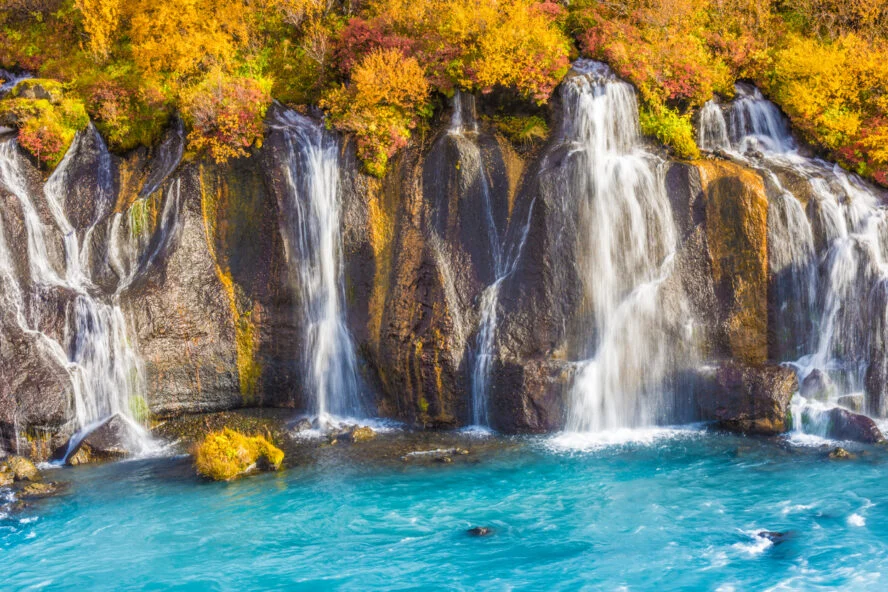
Icelanders will quietly tell you that September is one of their favourite months. The summer tourists have left, the roads are still mostly open, and the landscape turns extraordinary shades of amber, rust and gold. Þingvellir National Park — already one of the most historically significant places in the country — becomes visually stunning as autumn settles in.
This is cultural season. The Reykjavík International Film Festival screens work from across the world. Iceland Airwaves music festival brings the city alive in November, with shows in proper venues and surprise performances in bars, bookshops and swimming pool changing rooms. Galleries and museums are running full programmes, and you’ll have space to actually stand in front of something and look at it.
The Réttir — the traditional sheep and horse roundup — happens across the countryside in September. Farmers gather their animals down from the highlands in a process that’s been the same for centuries. In some areas, you can join in. It’s chaotic, atmospheric, and deeply Icelandic.
By November, winter is returning. The northern lights are appearing again. Advent preparations begin, and the Christmas markets aren’t far behind. If December feels too deep into the dark season, late November catches all of winter’s atmosphere while still holding onto something of autumn.
So, When Should You Go?
- For northern lights: December to February, with January being the sweet spot.
- For hiking and access to the Highlands: July and August.
- For fewer crowds and lower prices: April–May or September–October.
- For snow sports: February to March.
- For festivals and city culture: August (summer festivals) or November (Airwaves).
- For something you’ll find difficult to explain to people at home: Any time. Iceland has a habit of doing that.
One last thing: whatever month you’re there, check the weather forecast daily and take the road condition advisories seriously. Iceland’s beauty and its unpredictability are inseparable. That’s part of the deal, and honestly, part of the appeal.
Pack layers. Carry waterproofs. And leave a little room in the itinerary for the weather to make a decision for you — Iceland’s best moments often happen when the plan falls apart.