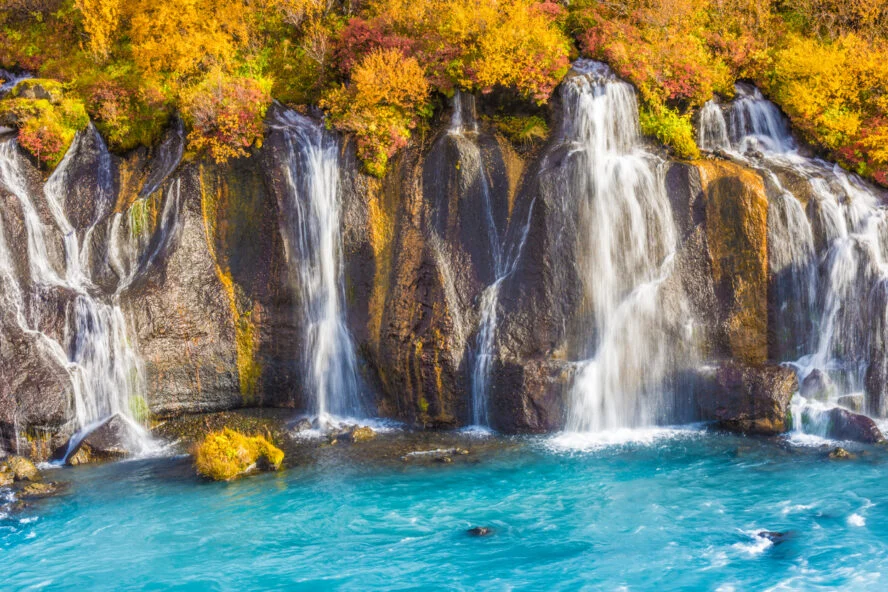
There are places in the world that feel finished. Iceland is not one of them.
The ground here trembles. Geysers punch columns of boiling water into arctic air. Volcanoes that were dormant yesterday crack open overnight. And yet, somehow, this restless, volcanic island in the North Atlantic has become one of the most quietly addictive destinations on earth — not despite its raw, unfinished edges, but because of them.
Whether you’re chasing curtains of green light across a winter sky or wading into a milky blue geothermal lagoon at midnight in summer, Iceland does something to you. It recalibrates your sense of what’s ordinary. Here’s what to do when you get there.
1. Chase the Northern Lights (and Let Them Humble You)
Nothing quite prepares you for the northern lights. You can watch footage, look at photographs, hear people describe it — and still, when those green and violet ribbons start moving across a genuinely dark sky, something in you goes quiet.
The aurora borealis doesn’t perform on command. It rewards patience, cold tolerance, and a willingness to stand in a field at 1am. Track the forecasts, get away from Reykjavík’s light pollution, and give it more than one night. If you want a head start on understanding what you’re seeing, Aurora Reykjavík in the city or the Perlan museum make for excellent primers.
Worth knowing: the Hotel Rangá in South Iceland runs its own observatory with two proper telescopes and a roll-off roof. On a clear night between aurora shows, the stars alone are worth the trip.
Can’t make it in winter? The summer solstice brings its own spectacle — the midnight sun. Head to Arctic Henge in Raufarhöfn, a modern stone monument designed to frame the sun at its lowest arc. Eerie, ancient-feeling, and completely unforgettable.
2. Step Inside Iceland’s Living History
Icelanders have a particular relationship with their past — they don’t just commemorate it, they inhabit it. Living history museums here are the real thing: people in period dress baking over open fires, demonstrating blacksmithing, telling sagas as though they happened last Tuesday.
At Eiríksstaðir in West Iceland, you can walk inside a replica Viking longhouse built on the very site where Eiríkur Rauði (Erik the Red) is thought to have grown up. At 1238 – The Battle of Iceland, VR headsets drop you into one of medieval Iceland’s bloodiest civil conflicts. It’s surprisingly gripping.
Each summer near Akureyri, the medieval marketplace at Gásir reopens. You’ll find charcoal being made from birch, wool being dyed with foraged herbs, and — yes — a witch reading runes. Try your hand at archery. Watch someone get (harmlessly) egged for theft. It’s strange and joyful in equal measure.
3. Soak Until Your Shoulders Drop
Iceland’s geothermal bathing culture isn’t a tourist attraction — it’s how people actually live. The ground here is warm, the water comes up naturally heated, and at some point centuries ago, Icelanders figured out they might as well lie in it.
The Blue Lagoon near Keflavík remains the flagship experience: milky, mineral-rich water set inside a lava field, just 20 minutes from the airport. It’s busy, it’s beautiful, and it’s a legitimately good way to recover from a long flight.
But the scene has expanded dramatically. Sky Lagoon on the Reykjavík coast delivers a full Icelandic spa experience with a view of the Atlantic. Earth Lagoon Mývatn in the north sits above a lake surrounded by volcanic landscape. Geosea in Húsavík overlooks Skjálfandi Bay. Vök Baths near Egilsstaðir has geothermal pools that actually float in a lake.
If you want solitude over spectacle, the Húsafell Canyon Baths are reached by a guided hike through wilderness — the effort is the point.
One rule applies everywhere: shower with soap before you get in. It’s not optional.
4. Walk Through Landscapes That Look Like Another Planet
When the snow retreats in summer, Iceland reveals a hiking terrain unlike anything in Europe. Multicoloured rhyolite mountains. Rivers that look radioactively turquoise. Waterfalls that fall for so long they disappear into mist.
The Laugavegur trail — four days, roughly 55km, from Landmannalaugar to Þórsmörk — is one of the great long-distance walks in the world. The Fimmvörðuháls route links Skógafoss waterfall to the same valley via a ridge between two glaciers; it’s doable in one intense day or split across two.
In the east, the Stórurð trail (around five hours) takes you through a boulder field so dramatic it feels staged. In the Westfjords, the wild Hornstrandir Nature Reserve is so remote it requires a boat to reach — and rewards you with absolute solitude and some of the sharpest coastal scenery in the country.
5. Go Underground — Into Lava Tubes and Ice Caves
Iceland’s interior is full of cavities. Lava tubes stretching hundreds of metres, carved out when ancient flows cooled on the outside and drained from within. Ice caves in Vatnajökull — Europe’s largest glacier — that form each winter in colours from pale blue to deep cobalt, and vanish again in spring.
Víðgelmir near Húsafell is Iceland’s largest known lava cave, and guided tours take you past stalactites that took centuries to form. For ice, the caves inside Vatnajökull are accessible between October and March — and are genuinely otherworldly. Think cathedral ceilings in translucent blue. Don’t attempt them without a guide; conditions change fast.
For something more accessible, Þríhnúkagígur is a dormant volcano you descend by cable lift — 213 metres down into a chamber of brilliantly coloured rock. It’s one of the few places on earth where you can stand inside a volcano.
6. Eat Seriously Well (Iceland Has Michelin Stars Now)
It wasn’t long ago that Icelandic cuisine meant lamb soup and skyr. That era is over. Reykjavík now has three Michelin-starred restaurants — Dill (which started it all in 2017), Óx, and Moss at the Blue Lagoon — and a dining culture that treats local and seasonal ingredients with genuine reverence.
Matur og drykkur takes traditional Icelandic recipes and elevates them without losing their soul. Sümac brings Middle Eastern flavour to a northern latitude in ways that somehow make complete sense.
Outside the capital, Nielsen Restaurant in Egilsstaðir is a quiet gem — focused on East Icelandic producers, with a particular talent for game. Their reindeer dishes are worth the drive. Norð Austur in Seyðisfjörður pairs Japanese technique with Icelandic seafood in summer, and the result is remarkable.
In March, the Food & Fun festival brings international chefs to Reykjavík with a constraint that produces interesting results: they can only use Icelandic ingredients.
7. Watch a Volcano Erupt (Carefully)
Iceland has around 130 volcanoes, and one of them erupts roughly every three years. The Reykjanes Peninsula, near the airport, has been particularly active in recent years — fire cracking through fissures in the lava field, visible at night from miles away.
It’s spectacular. It’s also genuinely dangerous. Check Iceland’s Safetravel site before going anywhere near an eruption. Viewing points close without warning, gas can be in the air, and the terrain is punishing.
For something you can plan: the museum Eldheimar in Vestmannaeyjar tells the story of the 1973 Eldfell eruption, which buried part of the town overnight. A family home engulfed by lava sits at its centre — quietly devastating. Dormant Þríhnúkagígur lets you descend into a volcanic chamber safely. And Hekla, Iceland’s most infamous volcano, offers a long hike to a panoramic summit — it’s been quiet since 2000, which is either reassuring or not.
8. Go Out in Reykjavík — It Punches Well Above Its Weight
For a small northern city with eye-watering drink prices, Reykjavík’s nightlife is genuinely excellent. Happy hours start at 4pm — at Veður or Port 9 for a warm, pub-like atmosphere. Apótek and Slippbarinn for cocktails that are worth the money. KEX Hostel for live music and a crowd that doesn’t take itself too seriously.
Later in the night, Kaffibarinn and Prikið are where the real dancing happens. Dillon has “rock ‘n’ roll grandma” Andrea Jónsdóttir behind the decks on weekends, and the crowd loves her for it. Kiki Queer Bar is reliably joyful.
For the performing arts, Harpa concert hall on the waterfront is worth a visit regardless of what’s on — the architecture alone is a reason to stand outside and stare.
9. Swim Where the Locals Actually Swim
Skip the expensive spas for a night and do what Icelanders actually do: go to the local pool. Every town has at least one geothermally heated outdoor pool, and these are where real life happens — kids doing lengths, elderly couples in hot tubs putting the world to rights, teenagers staging small dramas.
Some merit a detour for their settings: Hofsós in North Iceland has a pool with a view of Drangey island and the fjord that looks almost too good to be real. Selárlaug sits next to a salmon river. Akureyri has proper waterslides. Most cost around 1,000 ISK.
The rules: shoes off at the door, shower with soap (naked — it’s not negotiable), and bring your towel to the poolside, not the locker room. First-timers get spotted immediately. Don’t be that person.
10. Winter Sports Beyond the Obvious
Iceland’s ski culture is low-key and genuinely good. Resorts around Akureyri, Ísafjörður and Oddsskarð offer downhill and cross-country runs without the crowds or prices of the Alps. The backcountry skiing season runs through May, and tours on Kaldbakur mountain near Grenivík let you skin up and ski to the shore.
Not a skier? Sleigh dogs on Lake Mývatn. Custom toboggans. Ski-Doo tours across glaciers. Snowshoeing through Dimmuborgir — a lava field of extraordinary shapes that in winter becomes a black and white moonscape — is quietly one of the best things you can do in Iceland with no particular athletic ability required.
11. Ride Horses That Move Differently From Any Others
The Icelandic horse is a breed apart. Compact, thick-coated, and bred in isolation for over a thousand years, it has two gaits found in almost no other breed worldwide: the tölt (an impossibly smooth four-beat amble) and the flying pace (a lateral two-beat gait so fast it looks like the horse is skimming the ground).
Riding one across an Icelandic highland, on a path that hasn’t changed in centuries, is the kind of experience that stays with you. Tours run from one hour for beginners to multi-day treks. The ancient Kjölur route across the interior highlands is one of the most popular.
12. Drink Craft Beer Made by People Who’ve Had a Long Winter to Perfect It
Iceland’s craft beer scene is younger than you’d expect — the first microbrewery only opened in 2006 — but it’s grown fast and gotten good quickly. In Reykjavík, Malbygg, RVK Brewing and Lady Brewery are all worth finding. The country also has distilleries producing vodka, aquavit, schnapps and herbal liqueurs from foraged Icelandic botanicals.
If you try one local spirit, make it Brennivín — a 40% caraway schnapps that’s been an Icelandic staple for centuries, sometimes called Black Death. It’s an acquired taste that most people acquire about halfway through the first glass.
13. Get on the Water
Iceland’s coastline rewards those who get out on it. Húsavík in the north is Iceland’s whale-watching capital, with genuinely high sighting rates — humpbacks and minkes are common, and blue whales surface occasionally. Tours also run from Reykjavík and Akureyri.
For something slower and more intimate, sea kayaking puts you at water level in coastal fjords and inlets. Operators in Stykkishólmur and Ísafjarðardjúp run tours that reward silence and patience. Seal-watching tours from Hvammstangi offer the particular pleasure of watching large, curious animals pretend to ignore you from a rock.
For the adventurous: Strýtan DiveCenter takes certified divers to a geothermal chimney on the ocean floor of Eyjafjörður. At Grímsey Island, right on the Arctic Circle, you can dive and snorkel alongside puffins.
14. Follow the Art in Reykjavík’s Open-Air Gallery
The Sun Voyager — Jón Gunnar Árnason’s steel Viking ship on the Reykjavík waterfront — is on every tourist’s camera roll. Rightfully so. But the city’s outdoor art goes well beyond the obvious.
Þúfa, an 8-metre grass mound in the Grandi harbour district, is worth climbing for its view and its strange, calming effect. Einar Jónsson and Ásmundur Sveinsson, two of Iceland’s most significant sculptors, have works scattered through the city that most visitors walk straight past.
Further afield: Eggin í Gleðivík on the east coast shows the eggs of 34 bird species in three dimensions along the waterfront at Djúpivogur. In Seyðisfjörður, Tvísöngur is a five-domed concrete musical sculpture — step inside the domes, sing a note, and the acoustics do something extraordinary.
Iceland rewards those who slow down long enough to feel it properly. Give it more than a long weekend. Let the weather make the decisions for a day or two. Stand outside at midnight in summer when the light refuses to leave. You’ll understand soon enough.